
My drive was like a muddy water slide
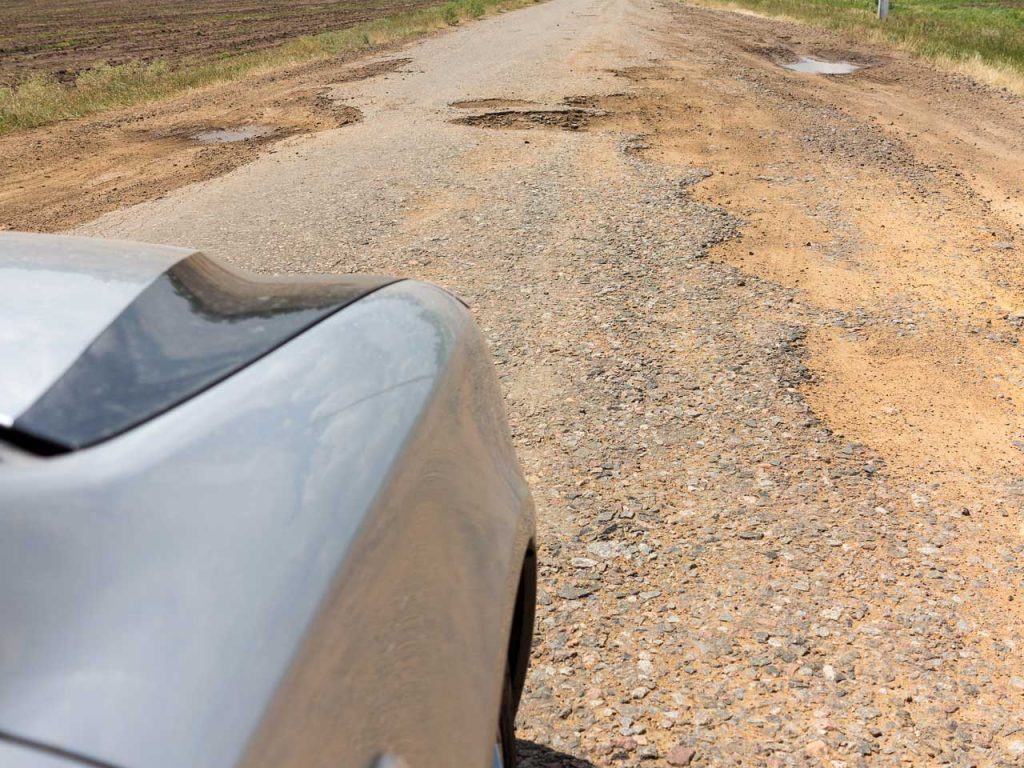
Recently we visited a customer on the outskirts of Tamworth who own a small hobby farm with a three hundred metre gravel driveway. Their first statement to us when we arrived (after a recent deluge of water) was, “my driveway was a muddy water slide”, which is not uncommon.
This year the weather has been quite extraordinary. The La Nina weather pattern has remained active in the tropical Pacific and continues to bring higher than normal temperatures and rainfall to coastal Australia. Here in Tamworth New South Wales, we have experienced many flash floods and extreme downpours.
All this weather activity has, of course, resulted in many washed-out roads and driveways. There are certain ways to fix and repair the damage caused by this weather. We always tell our customers to ‘plan for the worst – weather, that is.
So, where do we start? Drainage is the key. Before setting about repairing the existing road or driveway, we need to access the flow of water. Where does it start, and how is it collected, and what fall is in place. The best way to prevent any gravel washout on a driveway is to improve the drainage by installing swale drains, culverts, and channels.
Geotech fabric can be placed between a natural subgrade below and stone aggregates above in unpaved roads, serve not only as separators but also to increase the subgrade’s bearing capacity to take heavier traffic loads.
DGB stands for ‘Densely Graded Base’ and is a material used in various applications where a strong foundation is required, most commonly as a road base by the RMS, councils, and developments. Its the base of choice when a high level of compliance is required.
While still compliant with RMS specification 3051, DGS road base is a slightly lower grade of road base than the DGB variety.
DGS is commonly used in the construction of roads but can also be used in the following where an economical but compliant product is required:
● Under concrete slabs in construction
● In driveways and footpaths
● In carpark construction
● Under pavers
● On access tracks
One question our customers frequently ask is how to stop gravel from moving. One of the alternative options is a hotmix or spray seal option. This is where a base layer is placed on the driveway. Then a layer of hot mix or spray seal is applied, with the spray seal option 7mm-10mm aggregates are simply laid over the emulsion, so that they stick to it and are held fast, hotmix is applied through a paving machine and rolled in to place. This is a manufactured product made with much the same type of ingredients as Concrete, except bitumen is used to bind the mixture together instead of cement. A blend of aggregates (crushed rock), sands and fillers are passed through a heating drum to completely dry them and raise the temperature to around 160°C adding hot bitumen in the process.
There are many types of mixes for various types of applications. The most commonly used mixes are 14mm, 10mm and 7mm, referring to the largest aggregate in the mix. 14mm and 10mm are typically used on roads, 10mm and 7mm on car parks, driveways, sports courts, etc. The thickness the hotmix is laid depends on the traffic loading it will be subjected to.
Here is the list of the top 5 ways to stop your driveway washing away:
● Drainage
● Edging / curb
● Geotech Fabrics compacted gravel products, DGB OR DGS Limestone and Basalt road bases.
● Bitumen products (spray seal, hotmix)
If you need advice about your gravel driveway, contact the team at Benson Excavation today, we would be happy to talk you through your requirements.